

30 April 2025
Unlock Better Rates: Expert Tips for Contract Trucking Success
Discover key factors impacting contract trucking costs and expert tips to negotiate better contract rates for efficient, cost-effective freight transport.
A large volume of goods being moved around in local, regional, or global supply chains relies on contract trucking, wherein freight forwarders or shippers utilize the services of third-party trucking companies. Contract trucking companies provide expert services for the transportation of goods using trucks at negotiated and stable prices.
The prices charged by these trucking companies, however, are subject to changing market scenarios, including fluctuating fuel prices, regulatory changes, driver and vehicle shortages, and a host of other factors in a continuously evolving market environment. This makes it crucial for freight forwarders and shippers to understand pricing fluctuations in order to secure contracts at optimal rates and maximize returns on investment.
Factors Impacting Contract Trucking Prices
Trucking prices are influenced by a variety of factors that shippers and logistics providers must understand to negotiate effectively. Beyond fuel costs and capacity, operational elements such as cross-border logistics, regulatory compliance, and the complexity of supply chain coordination play a key role.
Europe’s logistics sector includes both multinational carriers and smaller operators, all adapting to growing digitalisation and sustainability demands. These providers navigate complex rules across member states, with oversight from institutions such as the European Commission’s Directorate-General for Mobility and Transport (DG MOVE) and national transport authorities, which enforce safety, environmental, and labor standards throughout the EU.
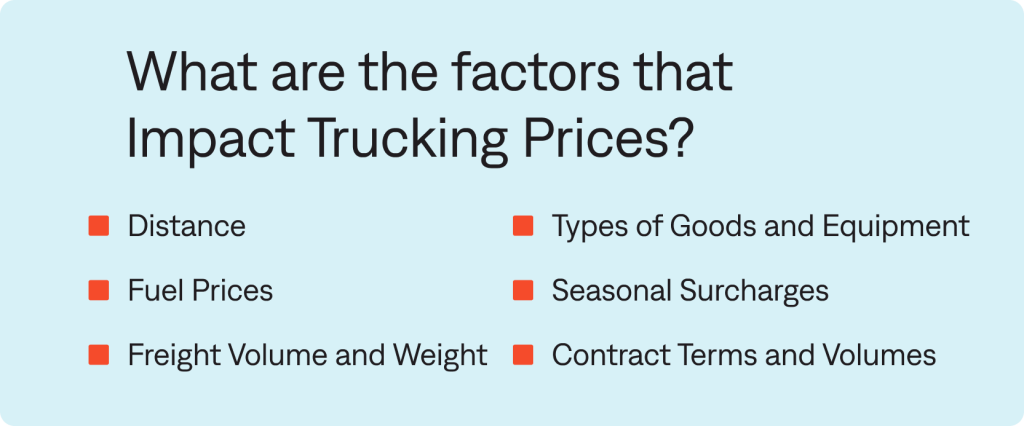
1. Distance
The distance the goods need to be transported by carriers is one of the foremost factors that impact the pricing of the trucking service. The longer the distance, the higher the base fare. The fares would further change depending on the complexity of the route, including, but not limited to, the terrain, whether it is an urban or rural road, border crossings, and tolls.
2. Fuel Prices
Fuel prices continue to fluctuate due to various reasons, including the prices of crude oil, supply chain disruptions, tariffs, and applicable taxes. Prices in Europe have roughly doubled in the last 20 years. There could also be sudden spikes in prices owing to weather conditions or geopolitical events such as wars. Freight forwarders or shippers must consider these factors when negotiating trucking prices. Additionally, fuel prices significantly impact international services, as varying costs can affect the efficiency and pricing of global trade operations.
3. Freight Volume and Weight
The type of cargo impacts contract trucking costs, which generally increase with the volume or weight of the freight. This is understandable considering more cargo often results in higher fuel consumption. However, partial load volumes can also result in higher pricing due to the lack of economies of scale, unless they are consolidated with freight from other shippers.
4. Types of Goods and Equipment
Certain types of goods require special handling facilities. Such goods might include perishable commodities such as fruits and vegetables, dairy products and medicines that require reefer facilities, timber logs that require long trailers, or hazardous goods such as industrial goods that require tanker trucks and fool-proof securing.
Due to the nature of the commodities and the equipment and skilled personnel required to handle and transport them, such goods often have different cost structures. Forwarding agents play a crucial role in managing these specialized goods, organizing international shipments, and providing end-to-end logistics solutions.
5. Seasonal Surcharges
Prices tend to rise during peak seasons, such as festivals, due to higher demand and a shortage of drivers. Such peaks can also be observed during inclement weather conditions, such as snowstorms and hurricanes, or in the aftermath of disasters like earthquakes and floods. Surcharges could also occur due to geopolitical events such as wars or internal unrest.
These seasonal surcharges can significantly impact the final delivery costs, as freight forwarders coordinate with multiple carriers across different transport modes.
6. Contract Terms and Volumes
Long-term contracts and consistent volumes often lead to reduced trucking costs due to better economies of scale and increased predictability. For trucking companies, it ensures a reliable business over a longer period, thereby making them more likely to offer discounts and favorable shipping terms in contracts.
Additionally, managing long-term contracts often requires specialized expertise in preparing and processing customs documentation, as well as navigating international regulations.
Tips to Remember While Negotiating Contract Trucking Prices
To effectively negotiate trucking prices and secure the best deal, it is essential to understand the profile of goods to be transported and the impact of cargo on negotiation strategies. Customers play a crucial role in the negotiation process, as their specific needs and shipment requirements can influence pricing and service agreements.
A comprehensive understanding of one’s own commodity profile would include knowing the volume of the consignments, the type of consignments, the distance and topography over which the commodities would be transported, and seasonal demand fluctuations. It is also important for shippers to be aware of the types of trucking companies in the market, their price ranges, track records, and any additional costs that may be incurred due to tolls, regulatory compliance, or specialized handling requirements.
Listed below are some key tips that can help a shipper or freight forwarder negotiate trucking price deals. Following these tips, we will address the most frequently asked questions related to contract trucking.
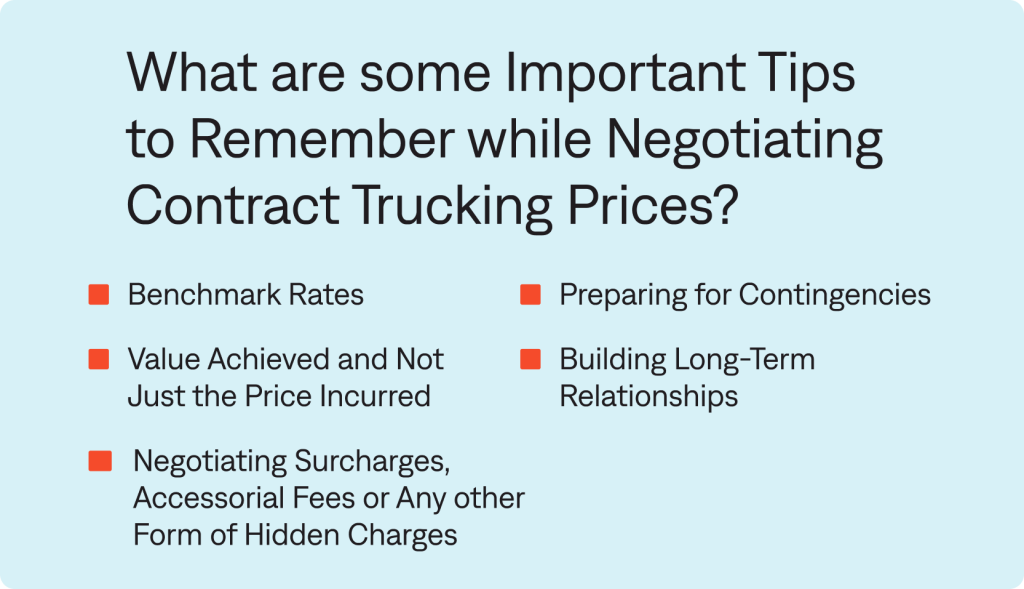
1. Benchmark Rates
Before entering into an agreement with a trucking company, it is important to have a basic understanding of the prevailing market rates and the role of logistics services in benchmarking these rates. This helps in evaluating fair rates and those that are overpriced. Rates can be identified through discussions on prices paid to different service providers, market intelligence platforms, or logistics consultants. Knowledge about current fares by different companies can be leveraged to arrive at a fair negotiated price for the trucking contract. The process of benchmarking rates involves analyzing data from various sources to ensure competitive pricing.
2. Value Achieved and Not Just the Price Incurred
It is essential to understand that finding the right contract is not just about picking the lowest price in the bidding process. While negotiating a contract, it is advisable to pick one that provides the best value, as that can indirectly save money through efficient logistics. A slightly higher rate can be acceptable if it results in fewer disruptions and better business performance such as on-time deliveries, secure delivery of goods, scalability and flexibility, and transparent communication. Additionally, coordinating multiple shipping modes for a single shipment can further optimize costs and enhance overall efficiency.
3. Negotiating Surcharges, Accessorial Fees, And Hidden Charges
Freight forwarders or shippers need to clarify whether there are any form of hidden charges or accessorial fees. The base fare could be low, however, the final amount in the invoice may surge up due to addition of fuel surcharges, toll taxes, loading and unloading charges and many more. It is important to clarify all the components of the total price.
4. Preparing for Contingencies
Businesses should consider their role in contingency planning to ensure smooth operations. Contingencies could include unforeseen circumstances such as vehicle breakdowns, natural calamities, road closures, or any such events that could hamper the transportation of the goods. Therefore, it is important to be clear on how such situations would be handled. This could help in determining the correct contract costs. Additionally, ensuring customs compliance can significantly impact the effectiveness of contingency planning by simplifying customs clearance for shipments.
5. Building Long-Term Relationships
Rather than focusing on the spot market or micro-contracts, it is crucial that the freight forwarder or shipper prioritizes long-term benefits with the trucking company, as it impacts the scaling of their business. Long-term contracts would often yield better results and reliability of service. Besides this, it could also lead to better pricing in the future and collaborative problem solving. Additionally, forwarding plays a crucial role in building these long-term relationships by managing critical tasks such as customs documentation, consolidation, and negotiation of shipping rates.
Choose Baton Transport for Affordable Pricing and Efficient Contract Trucking
Baton Transport has been at the forefront of the longhaul trucking industry in Europe, delivering affordable and efficient trucking services across multiple Schengen countries. One significant benefit of our services is the cost savings and enhanced operational efficiency we provide to our clients.
Our logistics network includes experienced agents who manage tasks such as load consolidation and document delivery, ensuring smooth coordination between shippers and carriers. The relay trucking system in Baton ensures that vehicles continue to move while drivers change shifts, ensuring better freight utilisation and resulting in fewer delays.
All trucks in Baton also have real-time visibility, which helps manage exception events if they arise. Further, Baton’s reach and network across the European Union ensure that the routes are familiar and predictable. These measures help reduce freight spend for clients, while providing unparalleled customer experience, building long-term business relations.
To know more about Baton Transport, click here.
Frequently Asked Questions (FAQ)
Contract trucking is a logistics service where a shipper or freight forwarder hires a third-party trucking company under a negotiated agreement to transport goods. It typically offers stable rates and dedicated capacity over a set period.
Key factors include distance, fuel prices, freight volume and weight, cargo type, equipment needs, seasonal demand surcharges, and contract terms such as duration and volume commitments.
To negotiate better rates, benchmark market prices, understand your shipment profile, clarify all surcharges and hidden fees, plan for contingencies, and build long-term partnerships with carriers.
Accessorial charges are additional fees outside the base rate, including fuel surcharges, tolls, loading/unloading, detention time, and specialized handling. Always confirm these upfront to avoid surprises.
Long-term contracts often provide better pricing, reliability, and service consistency. Spot contracts may offer flexibility but can be costlier and less predictable during peak seasons or disruptions.