

29 January 2025
How Contract Trucking Cuts Costs and Boosts Reliability for Freight Forwarders
Learn how contract trucking carriers like Baton Transport help freight forwarders cut costs and increase reliability
As a freight forwarder looking to collaborate with trucking partners, there are generally two types of feasible associations. Contractual agreements are the most popular option, where the freight forwarder signs a trucking contract with the fleet, offering stability through the length of the contract based on pre-negotiated terms determined on expected freight volumes. This provides predictability for freight forwarders (and their shipper clientele) within the broader logistics services framework.
On the other hand, most freight forwarders look to the spot market when demand exceeds their capacity. That said, forwarders need to be wary, as spot rates are highly volatile and fluctuate with market conditions such as seasonality, regional demand, and capacity shortages.
The stability in contract rates helps stakeholders budget accurately and plan efficiently, while the volatility of spot rates can lead to financial strain when the demand is high. To cut costs and increase reliability, many forwarders and shippers partner with contract trucking carriers for consistent shipments and spot rates for unexpected or overflow needs.
Who are Contract Trucking Carriers?
Contract trucking carriers are transportation companies that enter into long-term agreements with businesses, such as freight forwarders, freight brokers, manufacturers, or retailers, to handle specific shipping needs. These carriers commit to providing dedicated transportation services based on pre-agreed terms, which can include rates, routes, schedules, and vehicle types.
Unlike spot market trucking, where services are procured on an as-needed basis, contract trucking ensures consistency, reliability, and predictable costs. In most cases, the contract trucking company manages all operational costs, including cargo insurance, fuel, maintenance, and driver wages, as part of the contract.
For instance, a manufacturer producing goods on a daily schedule requires reliable transport to ship their products to distribution centers. Instead of relying on spot market trucking, the manufacturer partners with contract trucking carriers like Baton Transport.
Contracted carriers provide dedicated trucks that arrive at the manufacturer’s facility every morning, load the goods, and deliver them to distribution centers on time. Real-time tracking allows the manufacturer to monitor deliveries, while the carrier ensures timely arrivals, reducing spoilage and operational costs.
This arrangement ensures the manufacturer can meet customer demand without disruptions or unexpected costs. Freight forwarders who use contract trucking carriers gain stability, improve efficiency, and enhance customer satisfaction.
How Contract Trucking Saves Costs and Time
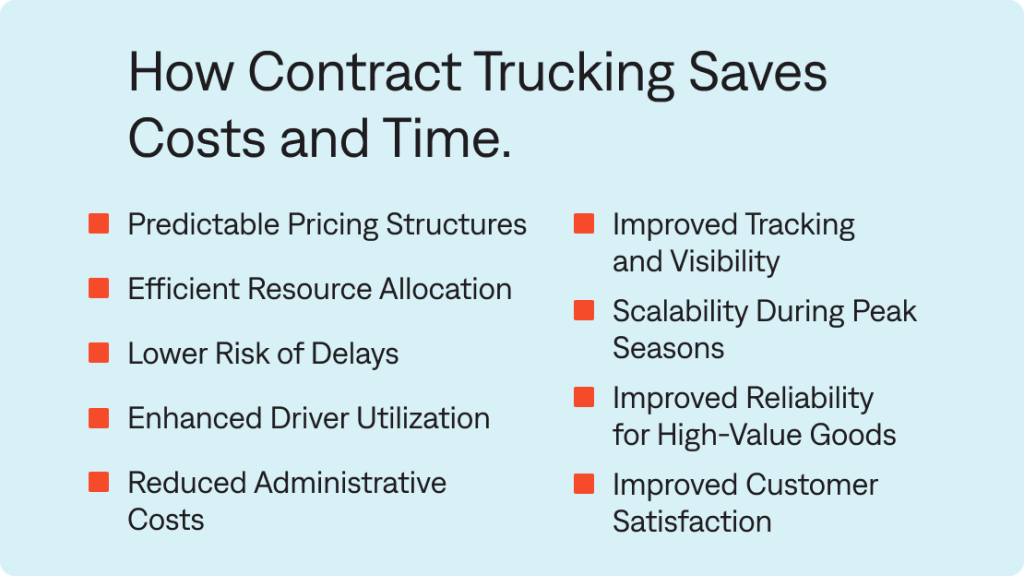
Contract trucking carriers offer dedicated resources, streamlined operations, and predictable service to help freight forwarders reduce costs and increase reliability. Here are a few reasons why freight forwarders favor this option.
1. Predictable Pricing Structures
To cut costs, freight forwarders should always find ways to manage supply chain volatility. One way to do this is to partner with contract trucking carriers to provide them with fixed pricing agreements that allow better budgeting and cost management. In such a partnership, freight forwarders avoid fluctuating spot market rates, which can spike during high-demand periods. In short, when freight forwarders hire contracted trucking carriers, their pricing structures will remain the same during the contract period despite seasonal pricing changes.
We at Baton Transport understand the importance of managing supply chain volatility for freight forwarders. We offer dedicated freight services with fixed or predictable pricing structures to help freight forwarders cut costs despite an unstable supply chain environment.
2. Efficient Resource Allocation
With contracted trucking carriers, freight forwarders do not have to worry about consistent truck availability during peak seasons. This shifts their focus to other critical roles such as delivering better customer service and growing their business.
Another way freight forwarders can use resources wisely is to avoid inefficient detours. Working with tech-forward fleets like Baton Transport enables better route optimization, besides assigning vehicles exclusively to specific clients. This process eliminates unnecessary mileage and reduces fuel costs and delays.
3. Lower Risk of Delays
Considering customers expect goods within the agreed-upon timeframe, maintaining schedule reliability is a metric worth pursuing. Contracted carriers help freight forwarders succeed at delivering goods on time by planning reliable delivery timelines since vehicles are readily available and routes are pre-determined.
Traditional trucks often experience idle time at warehouses due to multiple pick-ups and drop-offs in shared freight models. Baton Transport’s dedicated freight services minimize such delays, by optimizing routes, controlling delivery schedules, and helping freight forwarders adapt to changing environments without worrying about third-party shipping delays.
4. Enhanced Driver Utilization
Countless hours on the road often lead drivers to burn out, a common cause of delays and safety concerns.
Baton Transport solves this by running linehaul operations, where drivers focus on short-distance, nonstop journeys between major terminals. The relay model that Baton pioneered in Europe ensures that long-haul cargo moves between destinations nonstop while simultaneously ensuring driver well-being.
This model minimizes idle periods and ensures that large volumes of freight across Europe are delivered on time due to the continuous movement of shipments day and night.
5. Reduced Administrative Costs
When freight forwarders partner with contracted carriers, they save on administrative costs such as driver management, vehicle maintenance, and regulatory compliance. This also frees up time for freight forwarders to focus on core logistics activities such as customer service.
6. Improved Tracking and Visibility
When freight forwarders monitor the movement of goods, they are able to spot potential risks of delay and adjust in time. Most contracted carriers use advanced tracking technology such as GPS tracking to provide real-time shipment updates such that freight forwarders gain visibility into the status of their goods and predict accurately when goods will be delivered.
7. Scalability During Peak Seasons
The supply chain volatility is sometimes characterized by surges in demand. Freight forwarders need to be proactive in handling high-demand seasons, and the best way to do this is to partner with contract trucking carriers. Trucking carriers guarantee additional vehicles and drivers when shipment volume increases, encouraging scalability and growth.
8. Improved Reliability for High-Value Goods
When it comes to high-value goods such as electronics and pharmaceuticals, specialized trucking solutions are required to deliver them in good condition. Contracted carriers offer specialized solutions such as temperature-controlled vehicles or secure handling for fragile items. This lowers the risk of damage or loss and builds client confidence.
At Baton Transport, we specialize in single linehaul solutions, providing continuous, direct transport for shipments from origin to destination. This reduces the risk of damage or loss associated with multiple handling points, ensuring that high-value goods arrive safely and on schedule.
9. Improved Customer Satisfaction
Freight forwarders who follow the points we have discussed keep their customers satisfied. And when customers are satisfied, they are willing to partner with you over and over. We at Baton Transport know the importance of customer satisfaction, making our relay model a compelling reason to ensure customer delight.
Partner With Baton to Cut Costs and Increase Reliability in Freight Forwarding Services
Baton Transport’s contract trucking services provide international freight forwarders with cost-effective and reliable transportation solutions. Through predictable pricing, optimized vehicle utilization, reduced downtime, and enhanced reliability, Baton Transport supports freight forwarders in streamlining their operations and delivering superior service to their clients.
Contact us today to improve your overall supply chain performance and cut costs.

Frequently Asked Questions
Contract trucking carriers are transportation companies that enter long-term agreements with shippers to provide consistent trucking services at predetermined rates. These carriers ensure reliable capacity and stable pricing for shippers, helping to mitigate market volatility and secure efficient freight movement.
By offering stable, pre-negotiated rates, contract trucking shields shippers from spot market volatility and allows for better budget planning. Contract trucking increases reliability by guaranteeing consistent capacity and prioritizing scheduled shipments, reducing delays and supply chain disruptions.
Shippers and freight forwarders benefit the most from contract trucking carriers by securing stable rates, reliable capacity, and consistent service. Carriers also benefit from predictable revenue and long-term business relationships, which create win-win partnerships.