

14 May 2025
The Importance of Road Freight in Running EU Supply Chains
Discover why road freight dominates EU logistics, driven by seamless borders, advanced infrastructure, and rising e-commerce across the Schengen region
Road freight is a vital component of the European Union’s (EU) transportation network, providing a reliable and efficient way to transport goods across the continent. The EU trade policies aim to promote economic security and cooperation among member states, and road freight plays a crucial role in achieving these goals. As the most widely used mode of transportation in the EU, road transport accounts for a significant share of the total freight volume.
Baton Transport is one of the leading providers of road freight services in Europe, offering a range of solutions for shippers and freight forwarders looking to expedite freight movement across the continent. The company’s extensive network of terminals and fleet of vehicles ensures the timely and secure delivery of goods to destinations across Europe.
The EU’s road freight industry is subject to various regulations and standards, including those related to maximum weight, vehicle safety, and environmental sustainability. These regulations ensure that road freight operations are conducted safely and efficiently, contributing to the overall economic stability and growth of the region.
Freight Movement in Europe
While shipping dominates intercontinental freight movement, a major chunk of the inland freight movement is dependent on roadways. This is generally true for any region across the world. Official data from the European Commission states that the major share of trade in the EU is with other EU nations, with road freight being the major artery for trade flows.

The geographical proximity, harmonised regulations, and general economics naturally support road freight within the EU. With an extensive network of high-quality highways, road freight has therefore become the preferred mode in Schengen logistics.
The table below shows the split of freight movement in Europe across various modes of transport and the typical pros and cons of each mode.
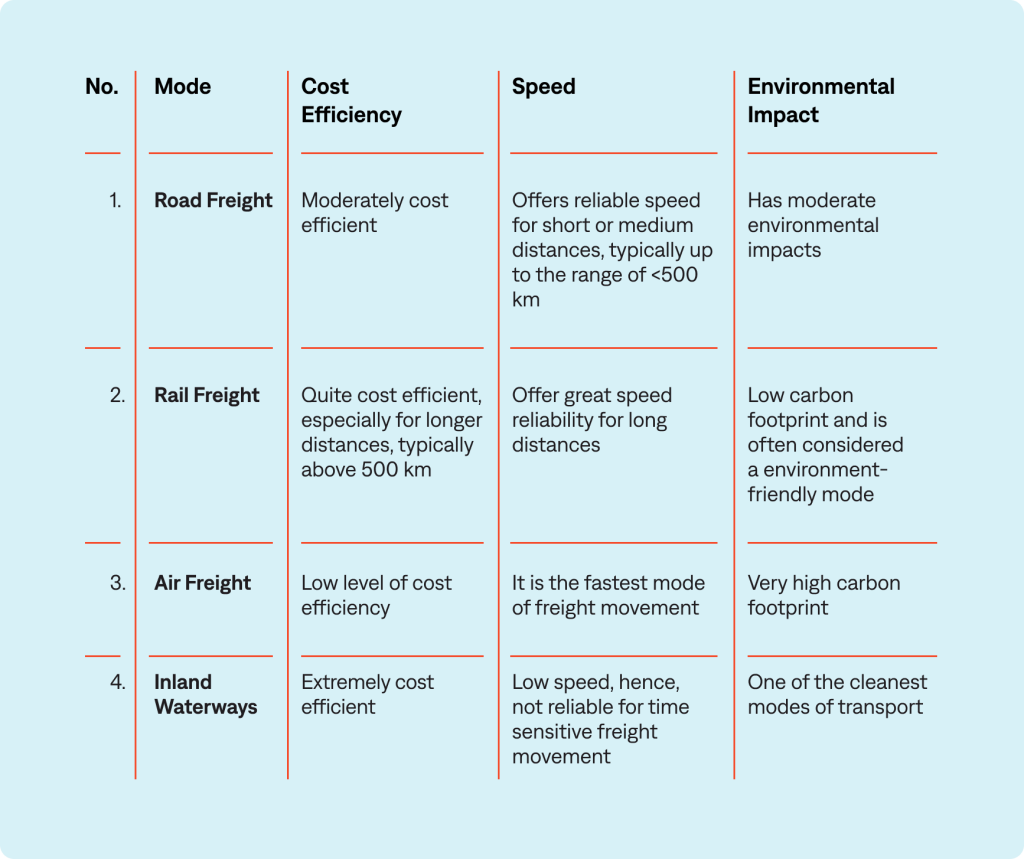
Comparing Road, Rail, and Air Freight
Road Freight
Intra-EU road transport accounted for a freight volume of 13.2 billion tonnes in 2023 and constitutes more than 50% of the total trade between EU nations. Road transport provides unmatched flexibility as it can not just provide long-distance freight movement, but also last-mile connectivity from the producer to the consumer. Commodities of daily use, such as food products and beverages, are commonly transported on trucks. Apart from this, it is also favourable for FMCG/ CPG, tobacco, and commodities traded via e-commerce.
Rail Freight
Rail Transport is often seen as a viable alternative to roadways, and the EU has long tried to push for policy changes for modal shift from roadways to railways. This has been primarily done with the motive of reducing carbon emissions and traffic congestion on roads. However, within the context of land transport, road freight offers greater flexibility with routes and timings, while rail freight is more cost-efficient and environmentally friendly for bulk transportation over long distances. Railways are not feasible for end-to-end connectivity and do not have flexible routes and timings.
However, rail freight is extremely beneficial in the case of bulk transportation of commodities such as foodgrains, coal, and cement. The economies of scale work better in the case of rail freight when the distances are higher.
Air Freight
Air freight plays a vital role in the movement of time-sensitive or cost-sensitive commodities. Such commodities might include vaccines, pharmaceuticals, perishable agricultural commodities, and many more. While air freight is an excellent means for the transportation of time-sensitive commodities, it is extremely expensive and has significant CO2 emissions.
Further, air freight is generally handled in major urban centres such as Paris and Frankfurt and cannot provide door-to-door delivery, unlike road freight. This limitation means air freight cannot offer end-to-end transportation when the commodities need to be picked from or delivered to remote or isolated locations.
Why Does Road Freight Dominate the EU and Schengen Region?
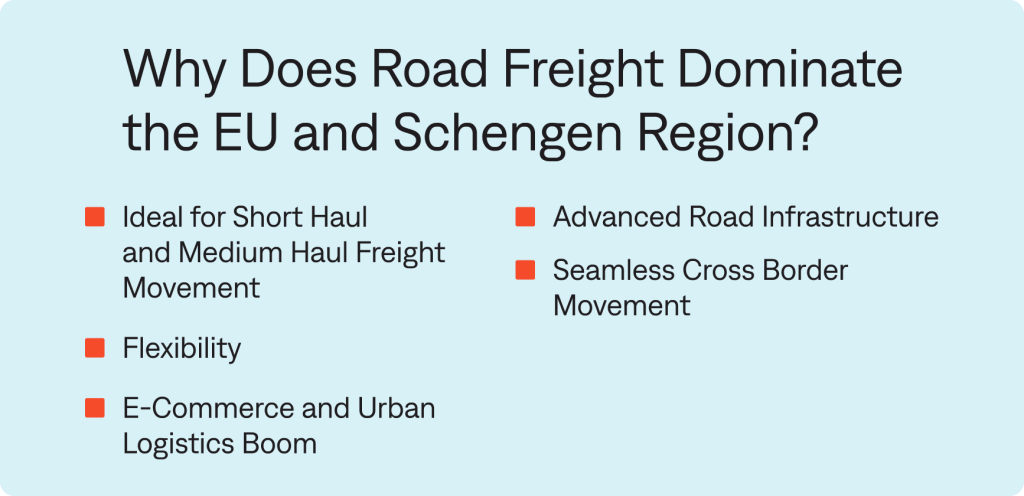
With harmonised cross-border regulations, unified trade rules, and strong internal demand and supply, the EU has made road freight the most efficient and preferred mode of goods movement across member states. The following sub-sections highlight why trucking dominates the freight movement in Europe.
1. Ideal for Short Haul and Medium Haul Freight Movement
Unlike wide-sprawled countries or regions such as Russia, the US, or China, nations in the EU are smaller in size and more compact. Hence, a large volume of intra-EU trade movement does not even exceed 500 km, therefore making trucking highly favourable. The importance of efficient loading and unloading in road freight operations cannot be overstated, as it ensures the timely and safe transportation of goods. Baton Transport has its presence in various nations such as Germany, Poland, Hungary, and Bulgaria, providing seamless road freight service to customers across the entire EU.
2. Flexibility
Trucking provides unmatched flexibility that is otherwise not possible with fixed schedules and transport nodes of railways and airways. Trucks can carry goods from the site of production to the site of consumption, located at specific points of loading and unloading, either within the same country or across international borders. The flexibility that trucks provide in terms of time and routes is what makes trucking much more desirable than any other mode of transport.
3. E-Commerce and Urban Logistics Boom
E-commerce has been on a surge across the world, and even in Europe. There has been a particular spurt after the COVID-19 pandemic. E-commerce itself has brought about a huge transformation in the logistics sector, particularly in the urban freight sector, with the rise of quick service and just-in-time (JIT) restocking. The benefits of road freight, such as cost efficiency, flexibility, and the convenience of door-to-door delivery, make it essential for supporting e-commerce and urban logistics. This is only possible using road freight, and hence, road freight has become all the more dominant in Europe in recent times.
4. Advanced Road Infrastructure
Infrastructure usually brings about significant transformation in nations, and the same is true of the EU. The extensive road system in Europe, including world-class infrastructure such as the popular Autobahn in Germany, combined with wayside amenities, parking facilities, charging infrastructure, and intelligent transportation systems (ITS), has made road transportation extremely efficient and highly favourable.
5. Seamless Cross-Border Movement
The Schengen countries allow free movement of people and goods across borders with harmonised regulations and without internal customs checks. This results in minimum delays while moving across countries and thereby allows the speedy movement of road freight. Road freight in the Schengen area is closely linked with other logistics services such as warehousing and distribution, providing a holistic approach to meeting customer needs. With small distances to cover within the EU, road freight is one of the most preferred modes of freight movement.
Baton Transport Leverages the EU’s Road Freight Landscape
Baton Transport has been in operation in multiple nations across the EU and has been a partner of choice for road freight. Baton Transport has long taken advantage of the infrastructure and cross-border regulations of the EU and helped dozens of shippers and freight forwarders move their commodities from origin to destination in a reliable, timely, and cost-effective manner.
The logistics sector in Europe is constantly evolving, with initiatives such as digital transformation, sustainability, and electric mobility. The trucking sector in Europe is poised to dominate in this environment, with the use of electric trucks and multimodal logistics. The EU has come up with the Trans-European Transportation Network (TEN-T) for planning and developing a coherent, efficient, multimodal, and high-quality transport infrastructure across the EU.
Set in the backdrop of such developments, Baton Transport has evolved to respond to the needs of the market, and will continue to do so to cater to future needs. Baton Transport is committed to sustainability by exploring eco-friendly fuels, carbon emission compensation, and innovative technologies aimed at reducing the ecological footprint of transportation. Connect with us today to learn how to move your freight better with Baton Transport.
Frequently Asked Questions (FAQ)
Goods for inland trade within the European Union are primarily transported via road freight, which remains the most commonly used mode due to its flexibility and reach. Other modes include railways, airways, inland waterways, and in some cases, pipelines for transporting petroleum products. Each mode has its own benefits depending on the type of cargo, distance, and urgency.
The majority of trade conducted by EU member states is with other countries within the EU. According to 2024 data, all EU member states—except Ireland and Slovenia—had over 50% of their total trade volume with other EU nations, highlighting the strong interconnectedness of the European market.
The European Union is actively promoting a modal shift from road to rail freight to reduce carbon emissions and alleviate traffic congestion. This is being supported by investments in infrastructure, such as the Trans-European Transport Network (TEN-T), and the promotion of sustainable, long-distance cargo transport options that offer lower environmental impact.
Road freight dominates intra-EU trade because travel distances are generally short due to the compact geography of the EU. Additionally, the harmonised cross-border regulations, efficient road infrastructure, and seamless access across Schengen countries make trucking the most practical and preferred choice for both short-haul and medium-haul shipments.
Road freight in the EU is typically categorized into Full Truck Load (FTL), Partial Truck Load (PTL), and Less Than Truck Load (LTL) shipments. FTL involves transporting goods that fill an entire truck, while PTL and LTL are ideal for smaller shipments that don’t require full truck space. These options provide shippers across all EU member states with flexibility based on cargo volume, urgency, and budget.